
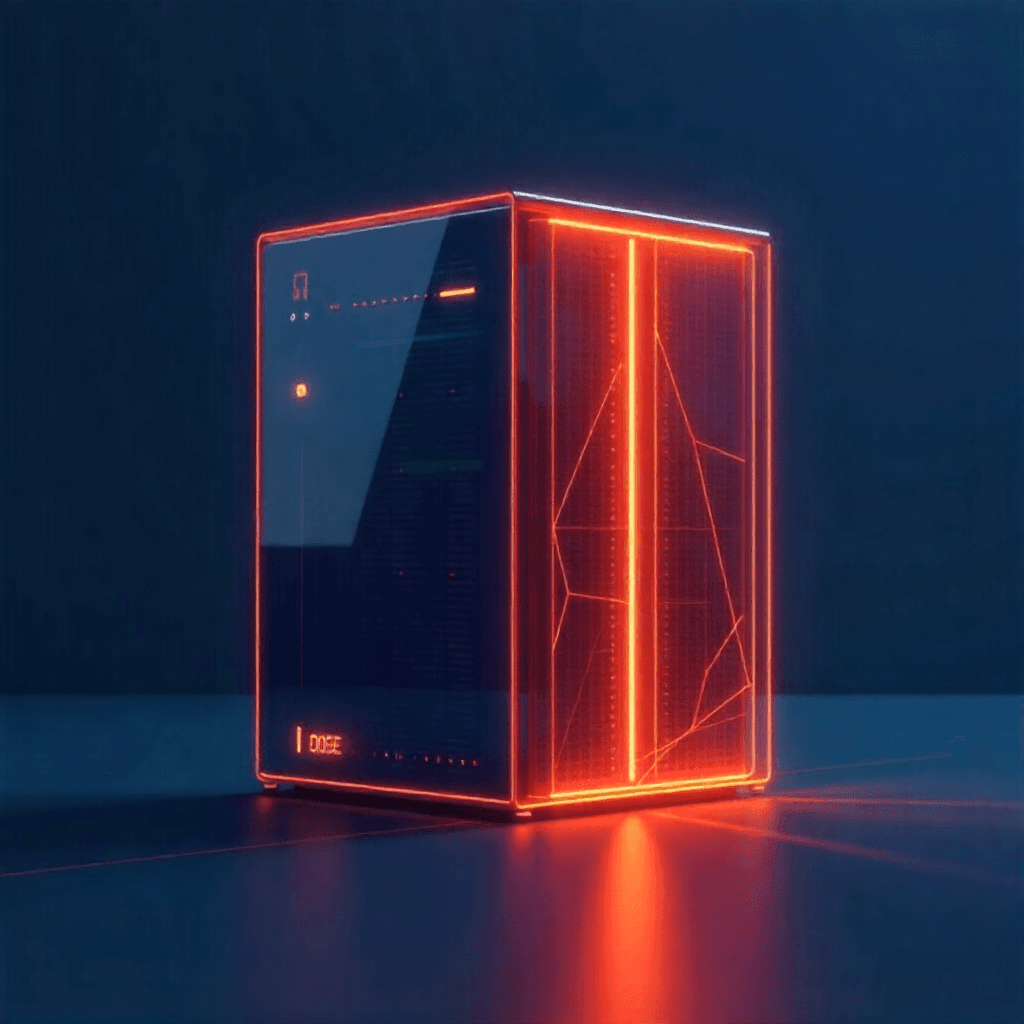
Introducing Graphcore’s GC200 IPU and 1U Petaflop Server
Graphcore has officially announced its second-generation AI compute platform: the Colossus Mk2 GC200 IPU and the IPU-Machine M2000, a 1U “pizza-box” server delivering a full petaflop of AI compute. This is a major leap for on-premise AI infrastructure, offering highly parallel, low-latency processing in a dense and modular package.
At a time when the demand for AI compute is skyrocketing, especially in enterprises developing large-scale models or latency-sensitive applications, Graphcore’s new system provides a more tailored, efficient alternative to traditional GPU clusters.
Key Development
Graphcore’s GC200 IPU is built on a 7 nm process and features 1,472 cores, running up to 8,832 threads. Each IPU includes 900 MB of in-chip memory, enabling large models to run without heavy reliance on external DRAM. The IPU-Machine M2000 houses four GC200 IPUs, delivering approximately 1 petaFLOP of FP16 compute. It also offers up to 256 GB of Streaming Memory and about 3.6 GB in-processor memory, all within a standard 1U chassis.
The M2000 supports IPU-Fabric, an ultra-low-latency interconnect with 2.8 Tbps bandwidth, enabling highly scalable, tightly coupled clusters. According to Graphcore, you can scale across machines to build up to 64,000 IPUs, achieving up to 16 exaflops in a full IPU-POD configuration. The system also integrates with Graphcore’s Poplar SDK, supporting frameworks like TensorFlow and PyTorch, and includes virtualization via “Virtual-IPU” for multi-tenant orchestration.
Graphcore has also established an Elite Partner Program, aligning with trusted global resellers and system integrators to support deployment and scale.
Synaphis Insight
- High-Density, Purpose-Built AI Compute: Enterprises seeking to build or expand dedicated AI infrastructure now have access to a solution optimized specifically for machine intelligence, not repurposed GPUs. The GC200’s architecture (dense cores + in-processor memory) enables highly efficient model execution, reducing data movement overhead and potentially lowering TCO for AI-intensive workloads.
- Scalable, Modular Deployment Strategy: The 1U M2000 form factor allows organizations to start small (even just one blade) and scale out as demand grows. This modularity aligns perfectly with phased adoption. Synaphis can help clients plan a staged rollout, validate performance with proof-of-concept workloads, and scale out to full IPU-POD systems when justified by utilization and ROI.
- Integrated Networking & Low-Latency Connect: Thanks to IPU-Fabric, Graphcore offers a tightly integrated networking layer that eliminates the need for costly external interconnects, such as InfiniBand. This not only simplifies data centre planning but also delivers fast collective operations ideal for distributed training. Synaphis’ Cloud & DevOps and AI & ML teams can design infrastructure and orchestration layers (Kubernetes, Slurm, etc.) around this fabric.
- Enterprise Readiness via Partner Ecosystem: With the Elite Partner Program, Synaphis could partner or act as a system integrator, enabling enterprises in various sectors (finance, healthcare, research) to tap into Graphcore’s technology with local support, deployment, and managed services.
Action Point
IT leaders and AI architects should conduct a benchmark pilot: procure a small M2000 deployment (or engage via a Graphcore partner) to run representative workloads, e.g., transformer-based training, inference, or sparse models. Analyze performance per dollar, power consumption, and scaling behaviour across nodes. Use this data to build a business case for broader adoption or hybrid deployment (IPU + GPU).
Broader Impact
- AI Infrastructure Innovation: This move further validates a shift in AI compute architecture, away from general-purpose GPUs to domain-specific, massively parallel processors.
- Democratizing High-Performance AI: Smaller to mid-sized enterprises can now access petaflop-scale, purpose-built compute without investing in massive GPU farms, enabling more organizations to build cutting-edge AI solutions.
- Energy and Cost Efficiency: With in-processor memory and a highly parallel architecture, IPUs may use power more efficiently per unit of compute, which aligns with sustainability goals.
- Strategic Positioning for Synaphis: By engaging now, Synaphis can position itself as a key partner for next-gen AI deployments — combining infrastructure design, performance tuning, and managed support.
Conclusion
Graphcore’s GC200 IPU and the M2000 1U server mark a major advance in AI infrastructure: delivering petaflop-scale performance in a compact, scalable, and cost-effective form. For enterprises serious about AI, this represents a strategic inflexion point, a chance to rethink compute architecture for the next generation of models.
At Synaphis, we’re ready to help organizations explore this shift through pilot deployments, architectural design, and full-scale adoption. As AI workloads continue to grow in size and ambition, our experience across AI & ML, Cloud & DevOps, and Data Analytics makes us the ideal partner to help you build, scale, and optimize for the future.
Reference Notes:
- Graphcore unveils New GC200 Chip and the Expandable M2000 IPU Machine (Graphcore, Nov 2025) Graphcore
- IPU-Machine M2000 Technical Specifications (Graphcore Datasheet) docs.graphcore.ai+2docs.graphcore.ai+2
- CRN analysis: “Chip Startup Graphcore Takes On Nvidia A100 With New IPU” (CRN, Nov 2025) CRN
- Graphcore Elite Partner Program Announcement (Graphcore, Nov 2025) Graphcore